
UC Systemwide Procurement Results 2026

UC Systemwide Procurement
UC Systemwide Procurement Achievements by Strategic Pillar
Economic and Community Impact
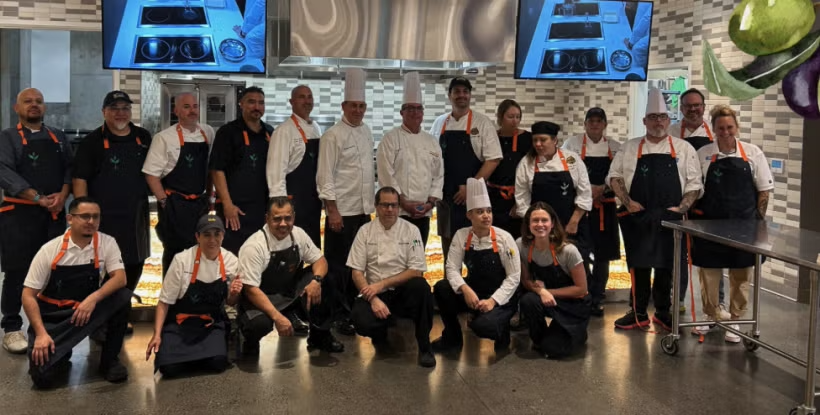
GCLC Phase II Strengthens UC Sustainable Food Sourcing
In FY26, UC’s Sustainable Food Sourcing Project advanced to Phase II, strengthening supplier partnerships, procurement data, and campus tools to expand climate-smart food purchasing.
The Challenge
Sustainable-food goals were hard to turn into daily purchases without reliable information, clear pathways for action, negotiated supplier partnerships, and sourcing methods for campuses and health centers.
The Approach
UC's Global Climate Leadership Council (GCLC) Sustainable Food Sourcing Project advanced into Phase II during FY26, strengthening supplier partnerships, procurement data, and practical tools that help campuses and health centers translate sustainability goals into purchasing decisions.
The Result
Teams are improving sustainability tracking, expanding access to climate-smart and responsibly sourced products, and working more closely with growers, distributors, dining operators, and sustainability experts. UC integrated sustainability language into systemwide produce and dairy contracts, launched a grass-fed and regenerative protein sourcing contract, and expanded the Maetadata pilot for clearer reporting.
Related Links:
Serving Up Sustainability: GCLC Phase II Report
Related Annual Report pillar page
Why it matters
These efforts help translate UC’s goal of sourcing 25% of food sustainably by 2030 into purchasing decisions while building a more resilient, transparent, climate-conscious food supply chain.
| At a Glance |
|---|
| 25% Sustainable food goal |
| 2030 Goal timeline |
| 1 Regenerative protein sourcing contract |
| 1 Expanded Metadata pilot |
| Contract Updates Integrated sustainability language |
57,000 Pounds of Sustainable Shrimp on Campus Menus
UC Davis, UC Santa Cruz, and UC Merced became the first U.S. institutions to serve 'Verified Green' Black Tiger shrimp, purchasing about 57,500 pounds in FY26 winter and spring quarters.

The Challenge
Campus dining needed a verified sustainable shrimp option that could be sourced at institutional scale from small-scale farms, not a one-campus specialty item.
The Approach
UC became the first major U.S. purchaser of 'Verified Green' Black Tiger shrimp sourced directly from small-scale farms in Vietnam. Through a partnership with Monterey Bay Aquarium's Verified Green initiative, UC Davis, UC Santa Cruz, and UC Merced became the first institutions in the nation to serve the environmentally sustainable seafood option.
The Result
During the winter and spring quarters alone, the three campuses purchased approximately 57,500 pounds.
Related Links:
Sustainability on the Menu: 'Green' Shrimp
Related Annual Report pillar page
Why it matters
Coordinated campus demand can expand markets for responsible small-scale producers while advancing UC’s sustainable-food goals and supporting healthier coastal ecosystems and communities.
| At a Glance |
|---|
| 57,500 lbs Of sustainable shrimp |
| 3 Participating campuses |
| Advances UC Sustainability goals |
Leading the Future of Sustainable Travel
UC earned a 2025 GBTA Foundation award for public-sector sustainability leadership, alongside systemwide efforts to report and reduce travel emissions and engage faculty and staff.

UC received the 2025 GBTA Foundation Acceleration Award for Global Sustainability Leadership in the public sector, recognizing work on Scope 3 business-travel emissions reporting and reduction. These awards honor business travel programs that are setting the pace for decarbonization in business travel and acting as innovators, advocates and changemakers across the industry. The GBTA is the world’s premier business travel and meetings trade organization.
The Central Travel Office (CTO) also hosted its third annual Earth Month Celebration for more than 460 faculty and staff, supported UC Berkeley’s Sustainable Travel Fair, and contributed to UCSF decarbonization and climate-planning efforts.
Related Links:
Learn more about the Global Business Travel Association
Related Annual Report pillar page
Why it matters
Business travel is part of UC’s Scope 3 emissions, so better reporting and campus collaboration help advance the university’s climate goals.
Advancing Economic Impact Through eProcurement Innovation
UC campus eProcurement systems route selected Fisher purchases to certified small business Possible Missions without changing the shopper experience; pilots at Berkeley and Davis led in 2025, with UCLA launched in summer 2026.
Challenge
Selected life-sciences purchases needed a way to reach Possible Missions, a certified minority- and woman-owned supplier, without changing the shopper's catalog experience.
Approach
The Systemwide eProcurement Systems and Life Sciences teams partnered with UC Berkeley, Fisher Scientific, and Possible Missions to implement JAGGAER’s Multi-Fulfillment capability for the first time at UC.
Result
Selected purchases are automatically redirected to Possible Missions, a certified minority- and woman-owned supplier, without changing the shopper experience.
Related Links:
Boosting Economic Impact with Supplier Integrations
Related Annual Report pillar page
Why it matters
Supplier integrations make economic impact spend part of the routine purchasing process and create a model other UC campuses can easily adopt.
Connecting UC Innovation to Global Opportunity
UC Systemwide Procurement, Human+Tech Week, and NativelyAI are creating a year-round platform linking California with global partners to advance research, talent mobility, technology transfer, and trade.
The Challenge
UC research, California suppliers, and student talent needed year-round international pathways for economic development, workforce mobility, technology transfer, and trade, not a single event.
The Approach
UC Systemwide Procurement, Human+Tech Week (HTW), and NativelyAI announced a strategic partnership creating a year-round Global Human+AI Exchange Platform connecting California with cities and regions worldwide.
The Result
This partnership drives economic development, workforce mobility, technology transfer, and trade expansion between California and international partners, enabling UC research, California suppliers and student talent to scale globally while granting participating cities access to world-class innovation, co-development capacity, and commercialization pathways.
Related Links:
Historic Partnership Launched to Power Global Human+AI Exchange
Related Annual Report pillar page
Why it matters
The exchange can help UC research, California suppliers, and student talent reach international markets while giving partner regions access to innovation and pathways for co-development and commercialization.
UC Strengthens Ties to Local Innovation
UC sponsored the inaugural Oakland Tech Week 2025, celebrating the entrepreneurs, innovators, and community leaders shaping the region’s future.

The Challenge
Systemwide Procurement needed visible, practical ways to connect with local entrepreneurs and potential future partners in the innovation community around UC's systemwide headquarters.
The Approach
UC sponsored the first Oakland Tech Week 2025, held November 17 through 21, and participated in an event focused on entrepreneurship, technology, and community leadership. UC has continued sponsorship of and participation in Oakland Tech Week 2026, being held September 28 - October 3.
The Result
The 2025 sponsorship gave UC early visibility into emerging startups, supported relationship-building, and demonstrated institutional commitment to Oakland's innovation community.
Related Links:
UC Strengthens Ties to Local Tech Innovation
Related Annual Report pillar page
Why it matters
Consistent engagement can help local companies understand UC, build relationships, and become future collaborators while connecting the university more closely to the surrounding community.
Strategic Partnerships
Turning UC's Purchasing Power into Public Value
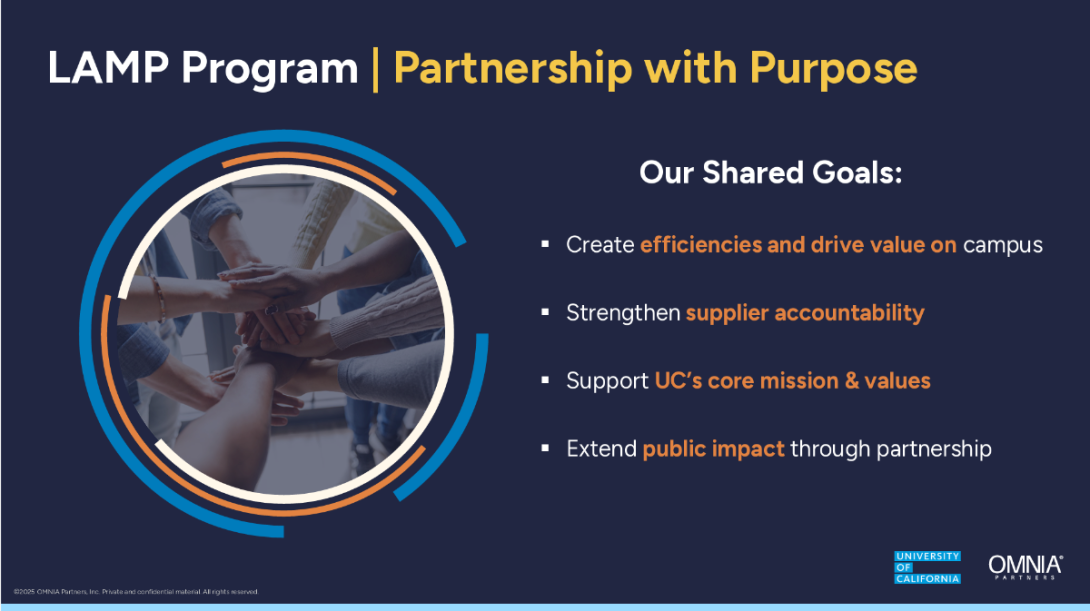
The LAMP program turns UC’s purchasing power into nationwide public value, driving $1.2 billion in FY26 contract spend while returning millions to campuses and supporting UC's mission.
What is LAMP?
The LAMP (Lead Agency Marketing Partnership) program is UC's contract portfolio available through cooperative purchasing organization, OMNIA Partners. UC Procurement acts as a lead agency to create a powerful portfolio of competitively bid and publicly awarded contracts that leverage the scale of UC purchasing power.
How does it work?
Through the LAMP program, state, local and education (SLED) agencies and eligible nonprofits can use UC-awarded cooperative contracts with no participation fees, saving time and resources while ensuring compliance. Removing the burden of performing RFPs helps participating organizations save money and time, while providing best value, policy compliance, sustainability, community impact, and more.
UC’s and OMNIA Partners’ robust team of procurement professionals promote the LAMP contract portfolio nationwide through a variety of strategic sales and marketing initiatives.
Results
With thousands of contracts adopted by public agencies nationwide, the UC LAMP program helps stretch budgets, accelerate purchasing, and deliver real community impact nationally. It also returns resources to UC that support campus programs and systemwide initiatives.
LAMP also helps UC aggregate demand, strengthen purchasing leverage and improve value over time. Use of LAMP contracts supports better pricing, stronger service standards and supplier accountability, while streamlining procurement, expanding supplier access, reducing risk and returning revenue to UC.
Related Links:
Lead Agency Marketing Partnership (LAMP)
Related Annual Report pillar page
Why it matters
LAMP gives UC campuses and public agencies access to competitively awarded contracts that save time, are compliant and strengthen purchasing value. It also extends UC’s public mission nationally while returning resources to UC.
| At a Glance |
|---|
| $1.2B In national spend by public agencies |
| 84 / 34 84 contracts across 34 categories |
| $5.9M Returned to campuses |
| $3M Reinvested into UC Procurement efforts |
Supplier Partnerships Power Greener Labs
Fisher Scientific and Zeiss provide up to approximately $200,000 annually for campus-led lab sustainability, helping fund projects and replace inefficient equipment.

Challenge
Campuses need flexible funding for laboratory sustainability, including equipment, rebates, outreach, or student staffing, tied to supplier partnerships rather than one-time grants.
Approach
The Systemwide Life Sciences team structured two major supplier partnerships to provide campuses with flexible funding for laboratory sustainability. Campuses may use the funds for equipment, rebates, operational projects, outreach, or student staffing based on local needs.
Zeiss contributes $50,000 each fiscal year for green-laboratory initiatives, with another $50,000 available when systemwide sales exceed $5 million, and Fisher Scientific has contributed $100,000 annually since 2022, providing $10,000 to each participating campus for rebates that help researchers replace inefficient equipment.
Result
Together, these partnerships represent approximately $200,000 in potential annual industry investment and have supported hundreds of equipment replacements, showing how supplier relationships can deliver measurable campus-level progress toward systemwide sustainability goals.
Related Links:
Connex•UC Travel Portal/Travel Webinars
Related Annual Report pillar page
Why it matters
Flexible supplier investment turns systemwide partnerships into practical, campus-level improvements—supporting researchers while advancing UC’s sustainability goals.
| At a Glance |
|---|
| $50,000 + $50,000 Zeiss annual contribution + $5M sales conditional contribution |
| $100,000 Fisher Scientific annual contribution |
| ~$200,000 Potential annual contribution |
| Hundreds Equipment replacements |
Strategic Partnerships That Improve the Travel Experience
Through strategic supplier partnerships and 28 FY2025–26 events reaching more than 12,500 faculty and staff, UC strengthened travel value, surfaced new ideas, and made its program more responsive to traveler needs.

Challenge
UC’s travel program spans multiple supplier categories and must keep pace with changing traveler needs, market trends, and sustainability priorities.
Approach
The Central Travel Office (CTO) manages suppliers as strategic partners, using quarterly reviews and industry forums to assess performance and shape travel offerings. Airline, hotel, car-rental, travel-management, and payment agreements deliver more when they are managed as partnerships, with in-depth quarterly reviews.
CTO also hosted 28 educational events in FY26, connecting preferred suppliers with more than 12,500 faculty and staff.And travelers make better decisions have a more satisfying experience when they can connect directly with preferred suppliers to get questions answered and learn more about benefits and options.
Result
UC gained a stronger voice in supplier decisions, while travelers learned about negotiated benefits and had more opportunities to ask questions and share feedback.
Related Links:
Connex•UC Travel Portal/Travel Webinars
Related Annual Report pillar page
Why it matters
Ongoing collaboration helps UC identify new ideas, strengthen value, and make its travel program more responsive to the community, elevating supplier relationships beyond contract administration.
| At a Glance |
|---|
| 28 Educational events |
| 12,500+ Faculty and staff attendees |
| 98% Event satisfaction rating |
| Quarterly Business reviews |
Global Travel Industry Leadership
Through UC's industry leadership and sustainability initiatives, the Central Travel Office (CTO) is helping shape sustainable-travel practices and amplify its voice worldwide.

Challenge
Sustainable-travel practice is set as much by industry buyers as by campus policy. UC needed a voice in that conversation alongside its own award-winning work.
Approach
During FY26, Central Travel Office Director, Debra Almason, continued serving on the GBTA Sustainable Travel Buyers Steering Group, working with global buyers, suppliers, and sustainability experts to advance industry practices.
Result
Combined with UC’s 2025 GBTA Foundation Acceleration Award and participation in the Global Climate Leadership Council Sprint 3 initiative, the role strengthens UC’s voice in national and international sustainable-travel discussions.
Related Links:
Connex•UC Travel Portal/Sustainable Travel
Related Annual Report pillar page
Why it matters
A stronger UC voice in national and global discussions helps shape sustainable-travel approaches across the industry.
Drive Value and Savings
UC Procurement Delivers $445.4 Million in Value in FY26
UC Procurement surpassed its FY26 4% target, delivering $445.4 million in value—4.1% of addressable spend—through data-informed sourcing and collaboration across the system.

Challenge
UC Procurement had to deliver significant value amid tariff pressures, federal research funding reductions, state budget constraints, and restrictive cost-management measures systemwide.
Approach
Teams combined category management, supplier engagement, strategic sourcing, data-informed targets, and collaboration with campus partners. Supplier negotiations and contract optimizations were central, and close partnerships with campus stakeholders ensured alignment with operational needs and institutional goals.
Result
UC Procurement delivered $445.4 million in value—4.1% of $10.85 billion in addressable spend—surpassing its $410 million FY26 target. These results reflect coordinated work across UC and procurement's contribution to financial stewardship and mission support.
Related Links:
UC Procurement Surpasses 4% Benefit Target in FY26
Related Annual Report pillar page
Why it matters
The results strengthen UC’s financial stewardship and help campuses manage cost pressures while supporting the university’s mission.
| At a Glance |
|---|
| $445M Total FY26 benefits |
| $410M Target goal |
| $36M / 8.7% Above target |
| 4.1% of $10.9B Addressable spend |
Delivering Value through the Managed Travel Program
In FY26, UC Managed more than 93,500 airline tickets and $45M in air spend, with an average fare of $406—below the $606 industry benchmark.

Challenge
Unmanaged air travel costs more. UC needed systemwide airline contracting that would keep average ticket prices below industry benchmarks.
Approach
The Central Travel Office (CTO) continues to maximize the University's purchasing power by delivering strong value through strategic supplier partnerships and systemwide contracting. During FY26, the Central Travel Office supported more than 93,500 airline tickets representing $45 million in managed air spend.
Result
UC travelers paid an average of $460 per ticket across domestic and international travel, compared with an industry benchmark of $606.
Related Links:
Related Annual Report pillar page
Why it matters
Strategic supplier agreements, unused-ticket management, and other traveler benefits helped UC stretch travel dollars while delivering a consistent systemwide travel experience.
| At a Glance |
|---|
| 93,500+ Airline tickets |
| $45M Managed airfare |
| $460 Ave UC ticket price |
| $606 Industry benchmark |
Rigorous Price File Review Pays Off
Systemwide review of 27 supplier price files held average increases to 3.7% and stopped a 20%-plus lab-supplier increase that could have cost UC Berkeley nearly $400,000 annually.

Challenge
2026 supplier price files could have pushed a major cost increase to campus buyers. More than 2.6 million SKUs needed review before those files went live.
Approach
Procurement reviewed 27 price files from 21 suppliers across UC covering more than 2.6 million SKUs and held average implemented increases to 3.7%.
Result
Nine noncompliant updates were declined, six corrected files were accepted after negotiation, and one supplier's 75.5% average increase was stopped. Most directly for Berkeley, reviewers prevented a 20%-plus increase from a major laboratory supplier that could have added nearly $400,000 in annual cost.
Related Links:
Rigorous Price File Review Pays Off
Related Annual Report pillar page
Why it matters
The result demonstrates proactive contract administration as a measurable budget-control strategy.
| At a Glance |
|---|
| 27 Price files reviewed |
| 21 Suppliers reviewed |
| 2.6M+ SKU's reviewed |
| 3.7% Controlled increase |
| $400,000 Cost avoidance |
Continuous Improvement
Procurement Data Analytics Hub for Data-Driven Results
UC’s Procurement Data Analytics Hub brings trusted dashboards, reports, and guidance into one place, giving teams a shared view of procurement performance—with its most-used dashboard surpassing 2,000 views.

Challenge
Procurement dashboards, reports, and training were scattered. Campuses needed a shared gateway to trusted spend, sustainability, supplier, and sourcing information.
Approach
In March 2026, Systemwide Procurement Services launched the Procurement Data Analytics Hub, a centralized gateway to dashboards, reports, training, documentation, and other resources. The Hub organizes analytics around common business needs, making trusted information easier to find and use.
Result
Procurement professionals across UC now have a shared view of spend, sustainability, supplier engagement, strategic sourcing, and other measures, supporting greater transparency and more consistent decisions. Adoption is growing: the most frequently used dashboard has surpassed 2,000 views.
As new capabilities are added, the Hub will continue to strengthen collaboration, analytical confidence, and data-driven procurement across campuses.
Related Links:
Explore Procurement Data Analytics Hub
Related Annual Report pillar page
Why it matters
Easier access to trusted data supports transparency, more consistent decisions, and stronger collaboration across campuses.
Building a Clearer Picture of UC Spend
UC’s data improvement program reviewed 3.3 million spend records, reclassified more than $121.7 million, and reduced unclassified spend by 36.6% across five campuses.
New Tool Expands Systemwide Spend Visibility
Launched systemwide in February 2026, the UC Spend Tool helps procurement teams explore supplier, category, and contract data faster; monthly visits have risen 250%, and 90% of campuses have participated.
Procurement Exchange: Shared Insights, Systemwide Impact
Monthly informational webinars turn timely procurement and beyond topics into practical, on-demand learning for UC professionals.
Challenge
Systemwide Procurement needed a regular forum for sharing emerging practices, developing staff capability, and helping UC shape professional practice, not only a response to the issue of the moment.
Approach
Systemwide Procurement created Procurement Exchange as a monthly webinar series featuring UC leaders, policy experts, category managers, external specialists, and campus practitioners. Sessions addressed academic priorities, sustainable sourcing, BUS-43, process mapping, supplier reviews, tariffs, artificial intelligence, and other changing issues.
Result
The series established a repeatable channel for thought leadership, practical learning, and cross-campus discussion. It supports Systemwide Procurement's shift toward anticipating change rather than responding only after issues emerge.
Related Links:
Procurement Exchange webpage
Related Annual Report pillar page
Why it matters
A shared learning forum helps procurement professionals connect strategy with daily work, spread useful practices more quickly, and build a stronger systemwide community.
Advancing Professional Services Category Management Across UC
Systemwide Procurement’s Professional Services team advanced its HR Consulting Services strategy and brought practical feedback to UC’s emerging category-management process, alongside the Hays workforce initiative at Berkeley.
Risk Management
Turning Tariff Pressure into Systemwide Action
UC Systemwide Procurement turned tariff uncertainty into practical guidance through three expert webinars and a live impact tracker, helping campuses prepare and respond strategically.

Challenge
Tariffs affected prices, availability, lead times, and contract decisions. Campuses needed shared information and coordinated negotiation rather than separate responses to the same market pressure.
Approach
Systemwide Procurement combined education, supplier engagement, shared reporting, and coordinated negotiation. UC launched a Tariff Impact Tracker for campus supplier notices and continued work on import visibility and potential refund recovery through the Automated Commercial Environment portal and customs-broker support.
Result
Three key suppliers, MillerKnoll, Fisher Scientific, and Dorm Life, agreed to 0% tariff impact, while systemwide agreement negotiations helped keep overall tariff impact to approximately 1%. Tariffs can affect prices, supply chains, and research imports; timely information helped UC teams anticipate costs, avoid delays, and make informed sourcing decisions.
Related Links:
Turning Tariff Turbulence into Strategy
Related Annual Report pillar page
Why it matters
A systemwide response gives campuses better information, reduces duplicated work, and improves UC's ability to manage cost and supply risk during volatile trade conditions.
| At a Glance |
|---|
| 3 key suppliers At 0% tariff impact |
| ~1% Overall impact |
| 1 Shared live Tariff Impact Tracker |
| 3 Educational webinars with experts and Q&A |
Risk Matrix Simplifies Insurance Decisions
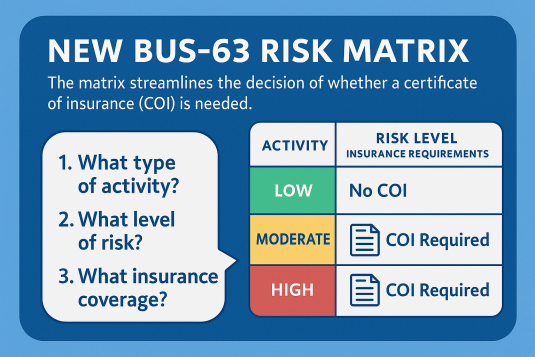
The BUS-63 Risk Matrix streamlines how departments decide whether a Certificate of Insurance (COI) is needed when working with suppliers, contractors, or external facility users.
Challenge
Departments needed a simpler way to determine whether a Certificate of Insurance was required and what coverage applied, with decisions that stayed consistent and proportionate to the work.
Approach
UC Risk Services developed the BUS-63 Risk Matrix to translate policy into practical questions about activities, risk levels, coverage, and Additional Insured requirements. They released it across the system in collaboration with the Systemwide Procurement Communications team.
Result
The matrix gives departments a faster, clearer path to insurance decisions and can reduce unnecessary paperwork for low-risk engagements.
UC Berkeley incorporated the tool directly into their BearBUY workflow. High-risk purchases require a COI on the requisition before goods ship or services begin, while Moderate and Low categories generally do not require collection. Berkeley Risk Management retains final authority based on the activity involved.
Related Links:
Risk Matrix Makes COI Decisions Easier
Related Annual Report pillar page
Why it matters
The matrix provides a faster, clearer path to insurance decisions and can reduce unnecessary paperwork for low-risk engagements.
BUS-43 Policy Update
UC issued a new interim version of BUS-43 (Purchases of Goods and Services; Supply Chain Management policy), effective January 26, 2026.
Opening Up the Terms & Conditions Archive
UC launched a publicly-accessible centralized digital archive to ensure clarity and consistency across all UC supplier agreements and to simplify contract compliance.